Tuesday, October 11, 2011
USMC Issues Production Delivery Order to HK
Heckler & Koch was awarded a competitive contract to produce the U.S. Marine Corps' new Infantry Automatic Rifle (IAR). The formal "Full Rate Production" announcement by the Marines caps a competition that began more than three years ago.
Designated the M27 Infantry Automatic Rifle, the lightweight, 11.62 pounds weapon with ancillary equipment, is a variant of the highly successful Heckler & Koch HK416 used by military, law enforcement, and special operations units in the U.S. and throughout the world.
The M27 IAR replaces the heavier, M249 SAW (Squad Automatic Weapon) which has been used by the Marines in Infantry Squads since the mid-1980s in the automatic rifle role. Both weapons fire the 5.56 mm NATO cartridge.
Read more

American Handgunner Reality Check Survive
The 2012 American Handgunner Reality Check Survive Special Edition features survival preparedness guides, outside-the-box techniques for coping without power, an inside look at the recent Joplin tornado, the 2012 Buyer's Guide and more.
Many readers know American Handgunner editor Roy Huntington lives just outside of Joplin, Mo. In "The Joplin Tornado: Anatomy of a Distaster," Roy tells of the aftermath, including his survival preparations that paid off, the search for survivors and the cleanup efforts. Much of the cleanup was done by the community itself, with groups searching the remains of buildings, clearing the streets of debris and setting up "instant restaurants" to feed the workers and homeless.
"It was a stunning effort to watch," Roy says. "A mobilizing effort on a tremendous scale, and unlike anything I had ever seen before, even in the other disasters I'd been involved with."
"Disaster Preparedness: Don't Wait Till It's Too Late" outlines the basics for food, water, shelter and medical needs, as well as what's needed to start rebuilding a normal life.
Monday, October 10, 2011
Tips for Buying a Used Glock Patrick Sweeney | Oct 06, 2011
Personally not a fan of Glock; but here is some information.
Not everyone buys new guns. A used firearm can have a great deal of useful life left in it, provided it had a decent amount of care from previous owners. Glocks are not different in that regard. A horribly abused Glock may not be worth much even as a parts gun. (Unless, of course, that horribly abused Glock is the only firearm you can lay hands on in the city of Dirt, Carjackistan, when the terrorists are trying to kick down your hotel room door. Then it may be literally worth its weight in gold or more.) A like-new-in-the-box used Glock may not cost much less than a brand-new Glock.
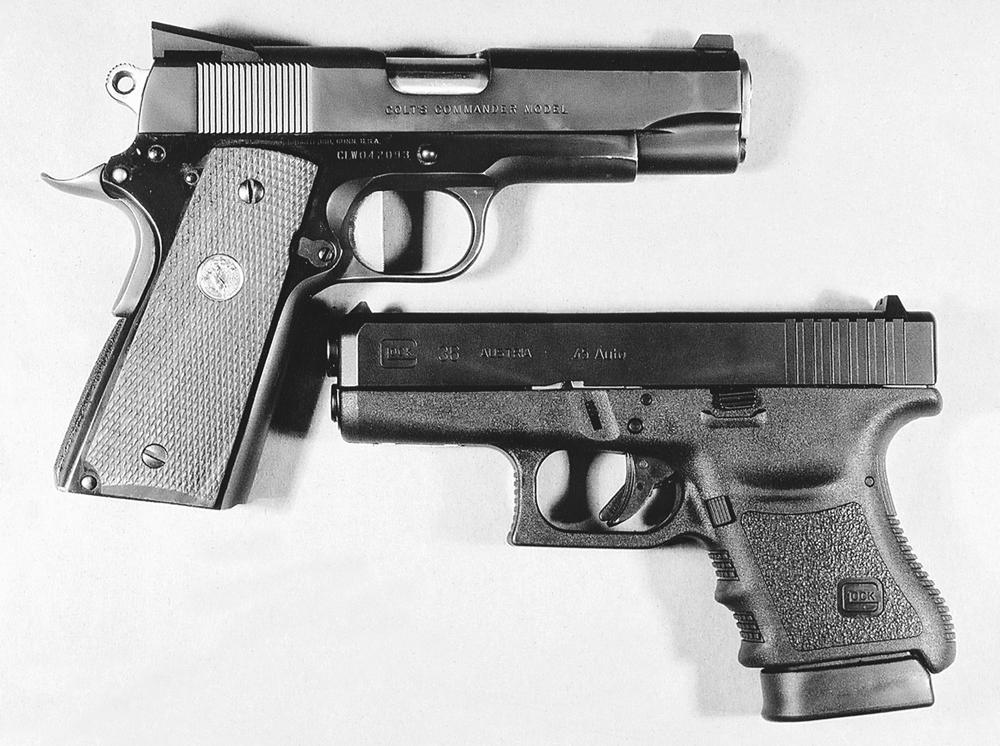
However, the durability of Glocks, and the lower percentage of their owners who experiment with them, tends to mean more Glocks survive in good shape than other firearms. Should you be offered a used Glock for sale, the main dance is settling on a price. There is hardly anything on a Glock that can’t be repaired, replaced or factory upgraded, and many of the factory upgrades are free. As a result, advice on buying used Glocks tends to be a lot less involved than that of buying other firearms.
If you drop your Glock slide, it can bend if it lands on the muzzle end extension for the recoil spring. Check this area before buying a used Glock.
What you are looking for are bargaining points. The small ones are things that are wrong or need upgrading, things that the factory will take care of free or at little cost. A G-17 with the old trigger parts can be fixed for free by Glock, but the same repair with new parts that have been experimented on will cost you should you send them back to Smyrna.
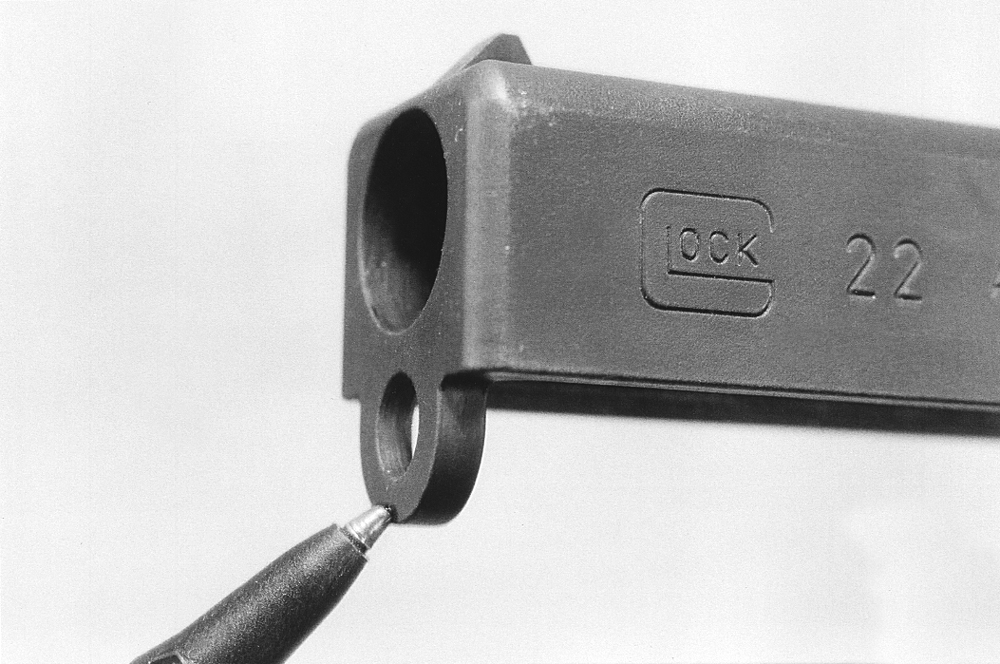
The good news is that the cracked slide might well be replaced by the factory for free or at little cost. The others? You’re on your own. Glock isn’t going to help you with a dropped slide, and the one that was machined will have a voided warranty. Don’t worry about the factory sights; Glock sights are cheap and easily replaced. At the current pricing, an armorer’s cost for a new set of sights is only $3!
Checking the Glock action. The safety plunger is blocking the firing pin.
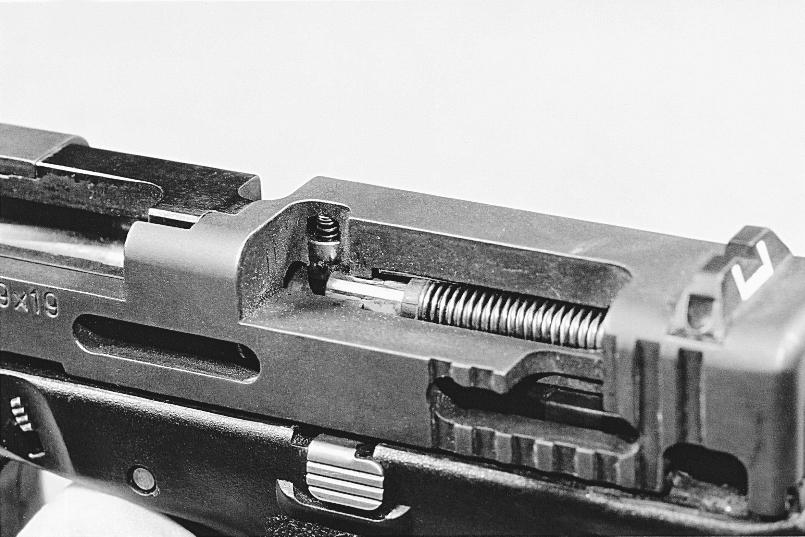
With the permission of the owner, cycle the slide and dry fire it. Try firing it without depressing the trigger safety. It should not fire. Try pulling the trigger normally and then hold it back and cycle the slide. Does the trigger return when you subsequently release it? If not, it may be due to a broken/bent trigger spring or a “trigger job” gone awry. The parts don’t cost much, so bargain the price down as much as you can but don’t expect the owner to budge much.
The firing pin being cocked.
Disassemble and inspect the slide and barrel. Is the barrel clean? Unmarred? Look down the bore. Do you see dark rings? Those are bulges in the barrel from lodged bullets being shot free. A new barrel costs money. At the armorer’s cost, a Glock barrel runs $95 to $125, with compensated barrels running up to $140. Aftermarket Match barrels can run up to $200. If the barrel is bulged, bargain hard, for a replacement won’t be cheap.
Look at the slide, in the breech face area. Inspect the area around the firing pin slot.
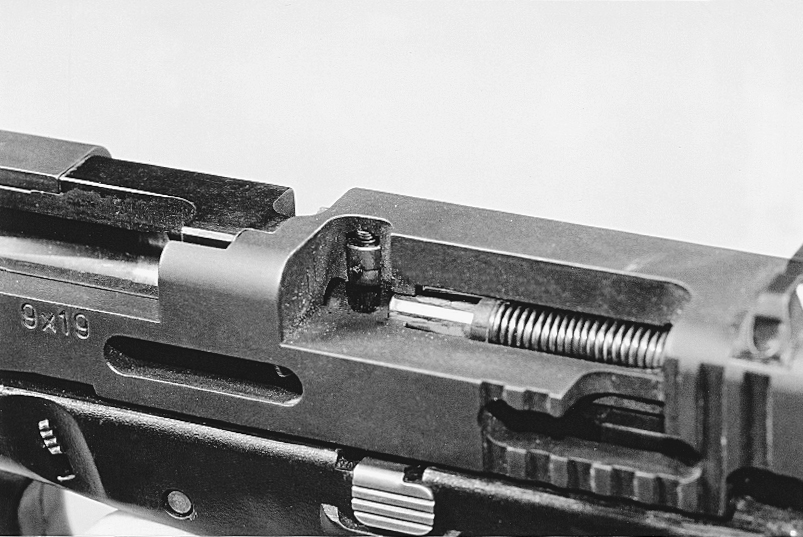
The firing pin fully forward.
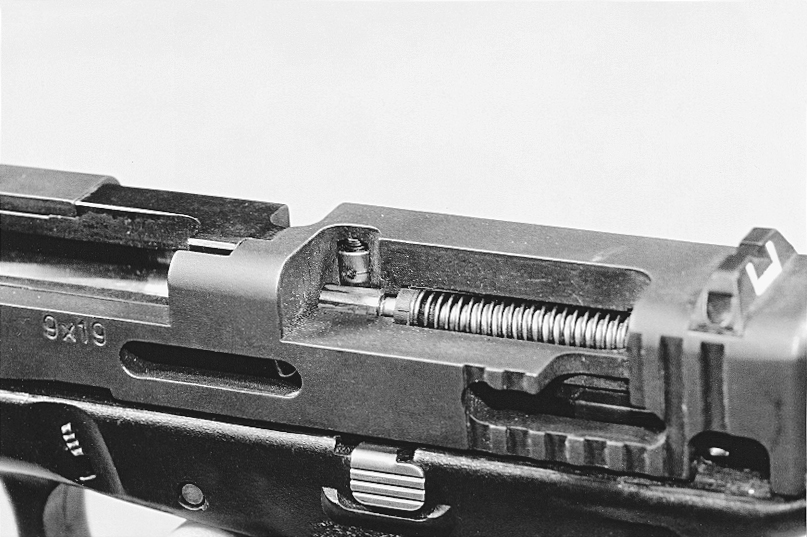
In a very high-mileage 9mm, fed many rounds of +P or +P+ ammo (as some police departments use), you may find the area around the firing pin slot eroded or even peened back. The erosion comes from pierced or blown primers jetting hot gases back at and through the firing pin slot. If you find those signs you should remove and check the firing pin to make sure it is in good shape. The peening comes from the high pressure setback of the primer. The wall between the breechface and the firing pin tunnel isn’t thick (it can’t be) and the repeated hammering from a steady diet of P or +P+ loads can peen it back. Yes, the Tenifer makes the slide hard, but the substrate isn’t hard or thick. If the area is made too hard by Glock, it may break. If it is too soft, it may peen. It must keep Glock engineers awake at night, worrying about it.
Read more
Monday, October 3, 2011
Brownell's Biggest-Ever Catalog Now Available
Every year Brownells catalog grows in page count and the number of products added, and this year is no exception. Their all new, Catalog #64 is a huge, 672 pages and contains more than 50,000 products, over 2,400 of them brand new since 2010. Six pages representing the newest category "Ammo" are dedicated to listing the most popular types and calibers of ammunition - the latest growth area for the company.
A popular feature in recent years has been the "Dream Guns" built by various suppliers and Brownell employees. There are 10 new ones in Catalog #64, all designed to highlight what can be built using products shown in the catalog.
Some of the thirty sections include: AR-15/M16; 1911 AUTO, Cleaning, Shooting Accessories, Optics and Accessories, Slings & Swivels, Rings & Bases, Specialty Rifle, Handgun and Shotgun Tools, Handgun, Rifle and Shotgun Sights, Metal Finishing, Books and Videos, plus Stockwork.

Company President Pete Brownell told us, "When we added ammo we wanted to do something no one else has so, we applied our flat-rate shipping and unconditional guarantee to all the ammo. What we added to Catalog #64 is just a sample, the full lines are available at brownells.com "
At Brownells everything is guaranteed period! ...Forever, 100%, with no restocking fees. Founded in 1939, they supply more than 50,000 firearms parts, accessories, gunsmithing tools and ammunition to armorers, gunsmiths, and shooters worldwide. Brownells provides free tech help and there's no minimum order size or small order fees. To place an order, or for more information, call 800-741-0015 or visit www.brownells.com and mention code PIH
Revolver Wizard Miculek Wins ESR Champ at Inaugural IDPA World Championship


Jerry's trademark S&W Model 625 .45 ACP, which he modified, hammered through the challenging stages during the monsoon-like weather. Drawn from a Blade-Tech holster, the N-frame .45 helped Jerry to a score of 411.79. Cliff Walsh took Second Master in Enhanced Service Revolver with a score of 421.7.
For more information, read or read more
Sunday, October 2, 2011
Loaded, or "Concealed" Carry in a Motor Vehicle
From: Ken Hanson book "The Ohio Guide to Firearm Laws (Oct. 2011)
Effective September 30, 2011, there are no regulations on how a licensee may transport a loaded handgun in a vehicle. The licensee needs to be aware, however, that laws concerning unauthorized ac-cess to a firearm (such as child endangerment) can still apply if the licensee is not maintaining control over the access to the firearm by others in the vehicle. The licensee also needs to be aware that he or she can never transport a handgun if they are under the influence of drugs or alcohol.
Effective September 30, 2011, there are no regulations on how a licensee may transport a loaded handgun in a vehicle. The licensee needs to be aware, however, that laws concerning unauthorized ac-cess to a firearm (such as child endangerment) can still apply if the licensee is not maintaining control over the access to the firearm by others in the vehicle. The licensee also needs to be aware that he or she can never transport a handgun if they are under the influence of drugs or alcohol.
THE LIQUOR FACILITY EXCEPTION
From: Ken Hanson book "The Ohio Guide to Firearm Laws (Oct. 2011)
THE LIQUOR FACILITY EXCEPTION granted to someone with a CHL goes into effect on September 30, 2011. This exception provides that the liquor facility statute, R.C. 2921.121, does not apply to a licensee so long as the licensee does not consume any alcohol (not even a sip) while in the facility, and is not already under the influence of drugs or alcohol when entering the facility. Please note that this is an exception, not a grant of a right. The exception sim¬ply says R.C. 2921.121 d6es not apply in that instance. The private property owner can still post a no-guns sign and trigger a criminal trespass violation under R.C. 2911.21.
Please note that the signs that are posted that begin with "Warning, if you are carrying a fire¬arm...." (usually printed on white cardboard stock, black lettering) are not "no-gun" signs but are statutory warning signs required by R.C. 4301.637. It would be a legal absurdity to say that these signs trigger a trespass violation, because such an interpretation would require a court to find that the exception passed by the General As¬sembly cannot ever apply.
Liquor licensees (i.e the people that own the restaurant) who have a CHL may have a handgun at their own licensed premises for defen¬sive purposes. Liquor licensees also have the ability to hire armed security as needed. As with any other private property owner, a liquor licensee may post a no-gun sign to keep the public disarmed, but then authorize individuals to carry a handgun despite the no-gun sign.
Subscribe to:
Posts (Atom)